
The Mobility Gap
Impeccable Surgical Execution, Imperfect Recovery
Technical surgical success doesn't always guarantee complete functional recovery. The real challenge begins after the procedure.
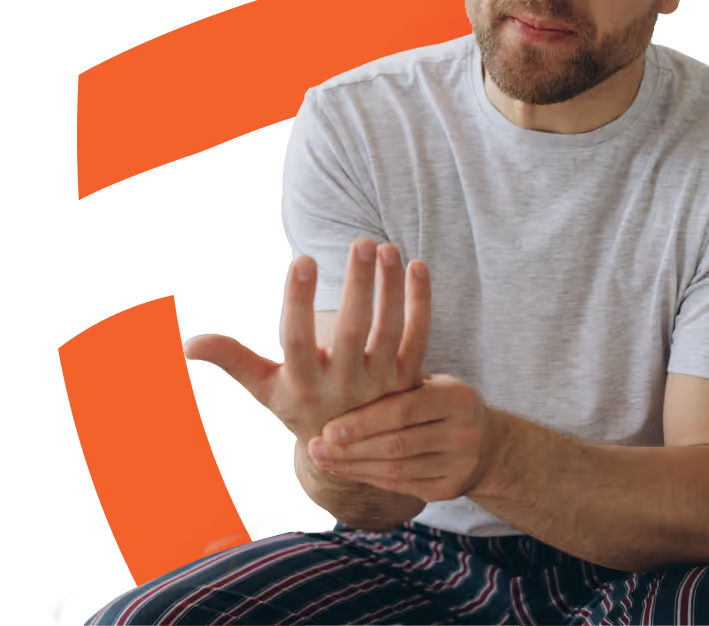
How BIG is the Problem?
This isn't an isolated issue—it's a systematic problem affecting hundreds of thousands of patients annually.
Current Solutions Fall Short
Current tissue barriers—membranes, fabrics, and films—face fundamental deployment challenges that limit their effectiveness in preventing adhesions.
The Problem with Existing Barriers:
- Difficult to deploy and position accurately
- Often dislodge from natural tissue movement
- Cannot conform to irregular tissue surfaces
- Leave gaps where restrictive scar tissue may still form
- 7-17% of flexor tendon repairs still require re-operation
The Impact is Real
For Patients
Limited mobility despite successful structural healing—what should be a return to normal activity becomes a lifetime of adapted movement, compensated function, and the psychological impact of incomplete recovery from an otherwise successful procedure.
For Surgeons
Perfect execution, imperfect outcomes—when your surgical skill successfully repairs the damage but biology fails the patient during recovery, creating the professional challenge of explaining why technical success doesn't guarantee functional restoration.
For Healthcare
The hidden cost of "successful" procedures—when structural repair is achieved but functional goals are missed, the system absorbs the downstream costs of ongoing therapy, workplace accommodations, and quality-of-life impacts that extend far beyond the initial treatment.

After witnessing countless patients struggle with limited mobility despite technically perfect surgeries, I knew we needed a better solution. B3 GEL™ isn't just another product—it's our answer to the mobility gap that has frustrated surgeons and patients for decades.
What If Surgery Could Deliver on Its Promise?
The limitations of current barriers aren't insurmountable—they're design flaws that can be solved. What's needed is a solution that works with the body's healing process rather than simply trying to block it, one that adapts to tissue movement and conforms to irregular surfaces while maintaining the biological environment necessary for optimal recovery.
4. 2023; 10: 1121892. Published online 2023 Apr 18. doi: 10.3389/fsurg.2023.1121892 Risk factors associated with tendon adhesions after hand tendon repair Qiyu Jia,# 1 , † Dongsheng Chen,# 2 , † Jian Guo,# 3 , † Xuefeng Luo, 1 Abudusalamu Alimujiang, 3 Jun Zhang, 3 Ningning Hu, 4 Yanshi Liu, 5 ,* Zengru Xie, 1 ,* and Chuang Ma 3 ,*
5. MedScout Platform Data
6. Mehrzad R, Mookerjee V, Schmidt S, Jehle CC, Kiwanuka E, Liu PY. Ann Plast Surg. 2019 Oct;83(4):419-423. 12 weeks represents the amount of time for total recovery after hand or upper extremity surgery.